
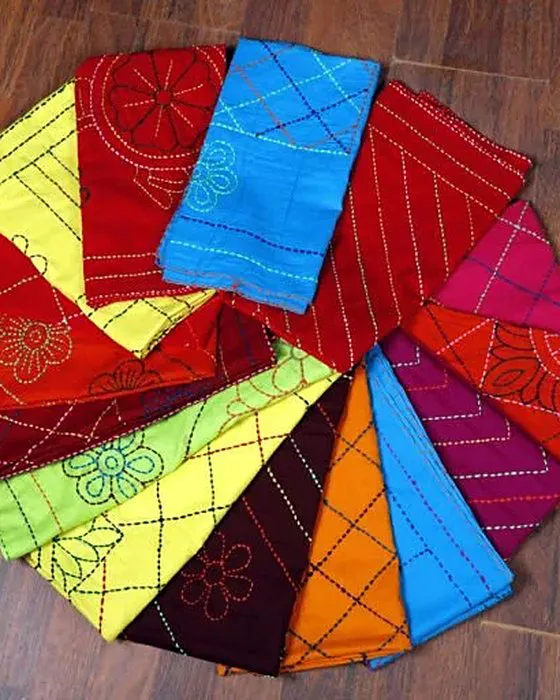
A nakshi kantha is a quilt that carries a family’s memory in its stitches. Made from layers of soft cotton and covered in hand-sewn patterns, it has wrapped Bengali babies, warmed beds and marked weddings for generations.
Here is what makes it special, what its motifs mean, how to spot a genuine handmade piece, and how to care for one so it lasts.
What is a nakshi kantha?
Nakshi kantha simply means “embroidered quilt.” Nakshi comes from naksha, the Bangla word for a pattern or design, and a kantha is a quilt made from layered cloth.
Traditionally, women stacked several layers of old saris, lungis or dhotis and sewed them together with a simple running stitch. Those same stitches draw the pictures, so the decoration is also what holds the quilt together.
The result is light, soft and gently rippled. No two are ever the same, because no two hands stitch the same story.
Where it comes from
Nakshi kantha grew out of rural Bengal, in what is now Bangladesh and the Indian state of West Bengal. It began as thrift: nothing was wasted, so worn-out saris were given a second life.
Women stitched in the quiet hours after household work, often sitting together in the courtyard. Mothers taught daughters, and patterns were passed down like family recipes.
Districts such as Jamalpur, Jashore and Rajshahi are still known for their kantha work. The craft is so woven into Bengali life that the poet Jasimuddin built his beloved narrative poem Nakshi Kanthar Math (The Field of the Embroidered Quilt) around a kantha that holds a love story.
Motifs and what they mean
Every motif on a kantha says something. Meanings vary from family to family, but these are the ones you will see most often.
| Motif | What it often stands for |
|---|---|
| Lotus (padma) | Purity and the cycle of life; often stitched at the centre |
| Sun and moon | Life-giving energy and the passing of days |
| Tree of life | Growth, family and continuity |
| Fish | Abundance and good fortune |
| Paisley (kalka) | Fertility and new beginnings |
| Birds, elephants, boats | Everyday village life, nature and journeys on the river |
The borders are usually filled with waves, vines or zigzags that frame the story stitched in the middle.
A baby’s first kantha
In Bengal, a newborn’s first blanket is very often a kantha. Mothers and grandmothers would begin stitching one months before the baby arrived.
Softness is the whole point. Layered cotton is gentle on delicate skin, breathes well in our warm climate and only gets softer with every wash.
That is why a baby nakshi kantha makes such a meaningful gift for new parents. It is perfect for cuddles, tummy time and wrapping up after a bath; for sleep, follow your paediatrician’s advice on safe bedding.
How to tell a genuine handmade kantha
Machine-made copies are everywhere, but a few quick checks will tell you what you are holding.
- Turn it over. Hand stitching shows on both sides as small, even dashes. Machine embroidery usually leaves a dense, stiff back with a different thread.
- Look for tiny irregularities. Slightly uneven stitch lengths are the mark of a human hand, not a flaw.
- Feel the ripple. Running stitches across the whole surface give a handmade kantha its gentle, wrinkled texture.
- Check the fabric. Cotton layers and cotton thread breathe better and soften with age.
- Think about the time. A detailed kantha can take weeks or even months to stitch, so a very low price is a warning sign.
Caring for your kantha
A well-loved kantha can last for decades with a little gentle care.
- Wash gently. Hand wash in cold water with a mild detergent, or use a gentle machine cycle inside a laundry bag. Wash it on its own the first time in case colours run.
- Wash before first use. This is especially important for a baby kantha.
- Don’t wring or scrub. Press the water out softly instead.
- Dry in the shade. Dry flat or on a line out of direct sun, which fades the thread colours.
- Skip the bleach. Avoid bleach and harsh stain removers.
- Iron on the reverse. Use medium heat on the back side if needed.
- Store it in cotton. Keep it folded in a cotton bag or cloth rather than plastic, and refold it now and then so creases don’t set.
Bring a piece of Bengal home
A nakshi kantha is more than a quilt. It is slow, careful work, family memory and Bengali heritage, all in one piece of cloth.
At Kito Style, our nakshi kantha collection comes in baby and king sizes, in many designs and colours. Browse the collection and find the one that tells your story.